Tuesday, June 24, 2008

Activities in Positano

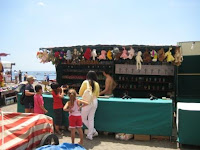
Something different that I also came across while I was in Positano was the activities available for everyone to partake in. Along the side of the beach was an area set up with a few carnival games. The games consisted of throwing a ball to knock over the bottle and another one with the same idea only this one you would use a gun to shoot over the object. The targets were a close distance from where you would stand to make your attempt at hitting the bottles. This made it easier to win a small prize. It wasn’t like at the carnivals or boardwalk games where they make it almost impossible to win. Almost everyone walked away with a souvenir. Most of the mementos offered were stuffed animals or little sand toys.
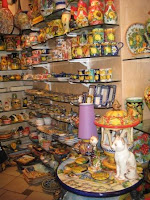
Painted ceramic pottery was also a huge deal in the small town. Many of the little shops contained hand decorated household items. There were mugs, plates, salt and pepper shakers, ash trays, and tea pots. Everything was priced at varying costs according to the size and detail of the piece. They were great gift ideas for my family and friends at home!
My visit to the Sistine Chapel

The Vatican museums took hours to get through and I didn’t even get to look at every piece of art. Some of the masterpieces that I passed while in the museum that I really enjoyed were the Laocoon, and the School of Athens. When I finally got to the Sistine Chapel there were crowds of people taking sitting along the sides of the room admiring all of frescoes that covered the walls. The Last Judgment consumed the entire back wall behind the altar. After seeing the elaborately detailed paintings it was no surprise to me that it took Michelangelo seven years to complete the project. The entire length of the wall was covered in souls of the dead floating up to face God. They were drawn with such detail in their facial features and muscular tones. Even though the painting didn’t reflect the faith of Michelangelo, it was ordered by Pope Paul III Farnese to warn all Catholics to remain faithful during the reformation.

When I looked up to the ceiling of the chapel I noticed the Creation of the Sun and Moon on the side of the painting closest to The Last Judgment. The whole picture was colored in black and white except for the sun and God’s sash clothing. Michelangelo did a great job of displaying the terrifying face of God as he is commanding the sun to light up the earth. I kept looking up at each individual painting and stopped for a couple minutes when I reached the Adam and Eve. In this picture God is reaching out his finger to Adam to pass on the spark of life. Another famous painting in the Chapel is The Original Sin. It was painted to demonstrate a woman whose legs turned into the snake of Satan after Adam and Eve tasted the forbidden fruit from the Tree of Knowledge. There was so much to look at in the Sistine Chapel I could have been there for hours examining the detail of the famous paintings. I’m so happy that I didn’t leave Rome without getting to see the legendary site.

Monday, June 23, 2008

Campo de Fiori

Near the Piazza Navona is the busy piazza of Campo de’ Fiori. It has always been known as a busy commercial area that is lined with stores, restaurants, and vendors for passer-byers on their way to Basilica di San Giovanni in Laterano and the Vatican. During its earliest years, the square was used for public executions. None more notable than Giordano Bruno who was immortalized into a statue in the piazza after he was burned by the Roman Inquisition after his ideas became dangerous. His statue by Ettore Ferrari describes Bruno as standing defiance against the Vatican. Another site in Campo de’ Fiori is the ancient fountain la Terrina or “the soup bowl” that is now used to keep flowers fresh. Inscribed on the fountain is “Fa del ben e lassa dire” which translates to “do well and let them talk,” an appropriate saying for the piazza. Currently, the square is filled with fresh foods, fruits, and flowers during the day. While at night Campo is where young people come out to meet and entertainment that is known as the nicest in the city.


“Campo De Fiori.” Campo de Fiori Guide. 2008. Rome Loft.com. 6/10/2008.


“Campo de’ Fiori.” Piazzas of Rome. April 27, 2008. Wikipedia Encyclopedia. 6/10/2008. http://en.wikipedia.org/wiki/Campo_di_Fiori

Hand Made Shoes in Positano


I purchased a pair of shoes during my stay in Positano that I watched the owner of the store hand make. I was able to choose the color strap that I wanted with whatever style I felt was the most comfortable. The tiny sandal shop had leather soles and various decorative straps covering every inch of the walls. There were plain straps of every different color of the rainbow. The ties that were decorated with jewels were more expensive and would accomplish a dressier look. People could either buy the sandals that were already made or chose a different design to be custom made. If you like a design but it wasn’t in your size the shoe man would make the same pair according to the length of your foot. The scent of the leather was so strong that you could smell it as you walked past the store. It would take an hour for them to be finished so while my parents and I were waiting we hiked down to the ocean to stick our toes in the cool water.

The Pasta Museum in Rome

As we all know Italians are known for their pasta, it is the land of pasta. That is why it is only fitting they have a museum devoted to the golden dish of the Roman Gods. Anyone who enters the pasta museum is instantly gratified as they explore the history and production of this world renowned commodity. Even though the vibrant informational displays are in Italian, those not accustomed to the language don’t get to miss out on the once in a lifetime opportunity as English speaking guides take visitors through the museum. Strolling through the museum, a visitor is encircled by pictures depicting the origin and history of pasta throughout the years. The museum also leads visitors through the process of how pasta is made, starting with its beginnings as wheat all the way until it reaches the end of its timeline to your dinner table. Inside, art work containing pasta is displayed throughout the walls, as well as a pasta theater for the true die hard fan of the Italian dish. The museum ensures the average pasta enthusiast is not left disappointed as they have been educated about pasta with exciting facts. For most, the pasta museum can be an exciting afternoon that tops any of the other museums in Rome.Unforntunately I haven't been able to see the museum because it is closed for the 2008 summer. Hopefully next time I come back to Rome I will be able to see the museum and learn more about the pasta industry.

Wednesday, June 18, 2008

Piazza Information

Piazza del Popolo is one of the most unified squares in Rome. Two of the same Neo-class buildings are located across from each other. An Egyptian obelisk stands in the center of the piazza. The piazza used to hold carnivals where public executions would occur.

Piazza di Spanga was originally used in the 16th century to help transport pilgrims as quickly from Rome’s Porta del Popolo. Today the piazza is filled with Renaissance and Baroque art in its surrounding churches and museums such as Villa Medici and Santa Maria del Popolo. The Spanish Steps are used my tourists and locals to sit and take pictures, read or hang out. Beirnini’s Fontona della Barcaccia is located beneath the steps.

Piazza della Repubbica was a redevelopment taken on when Rome became the capital of Italy after it was unified. Currently there are banks, cafés and agencies that replaced the shops that were once there. Mario Rutelli’s Fontona della Naiadi in located in the center of the square. The piazza is currently used for exhibitions, live performances, movies and lectures.

Piazza Directions


Beginning at Piazza del Popolo, find your way to V. le Gebrele d’Annunzio and walk through the Pincio Gardens. This street will soon turn into Viale d. Trinita. Follow this road straight until you reach a large palace called the Villa Medici. Turn right onto Piazza Trinita dei monti, the street located on the right side of the villa. This road will lead you straight to the Spanish Steps. After descending the stairs you will be standing in Piazza di Spanga. Make a left at the Fontona della Barcaccia and continue walking down Via due Macelli until you reach Largo del Tritrone. After making a right onto the street there will be a fountain in the center called the Fontona dei Tritrone in Piazza Barberini, Continue walking straight making sure to stay on Via Barberini. Turn right onto V. Versilla Salita da Tolerntino. Cross over Via XX Settembre and walk straight down Via Firenze. When you reach Via Nazionale turn left and walk straight into Piazza della Repubblica.